
Density Coiled Gravity
Density Coiled Gravity (DCG) is the premier artificial gravity technology of the galaxy. Fuel-expensive, highly unstable, and reliant on a Horizon Drive — but the closest approximation to real gravity.
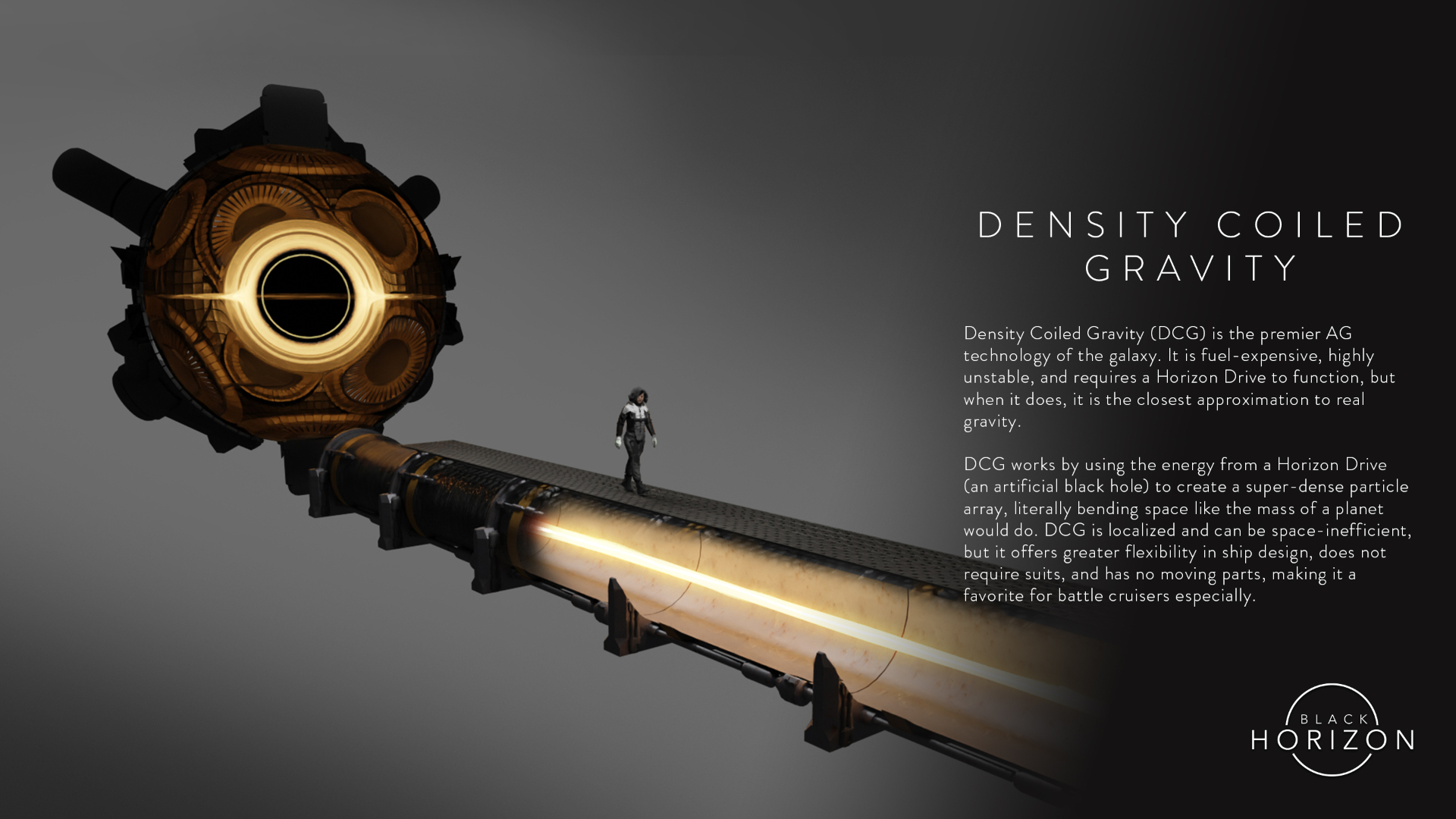
Density Coiled Gravity (DCG) is the premier artificial gravity technology of the galaxy. It is fuel-expensive, highly unstable, and requires a Horizon Drive to function, but when it does, it is the closest approximation to real gravity.
How it works
DCG works by using the energy from a Horizon Drive (an artificial black hole) to create a super-dense particle array, literally bending space like the mass of a planet would do. DCG is localized and can be space-inefficient, but it offers greater flexibility in ship design, does not require suits, and has no moving parts — making it a favorite for battle cruisers especially.
Layout aboard a cruiser
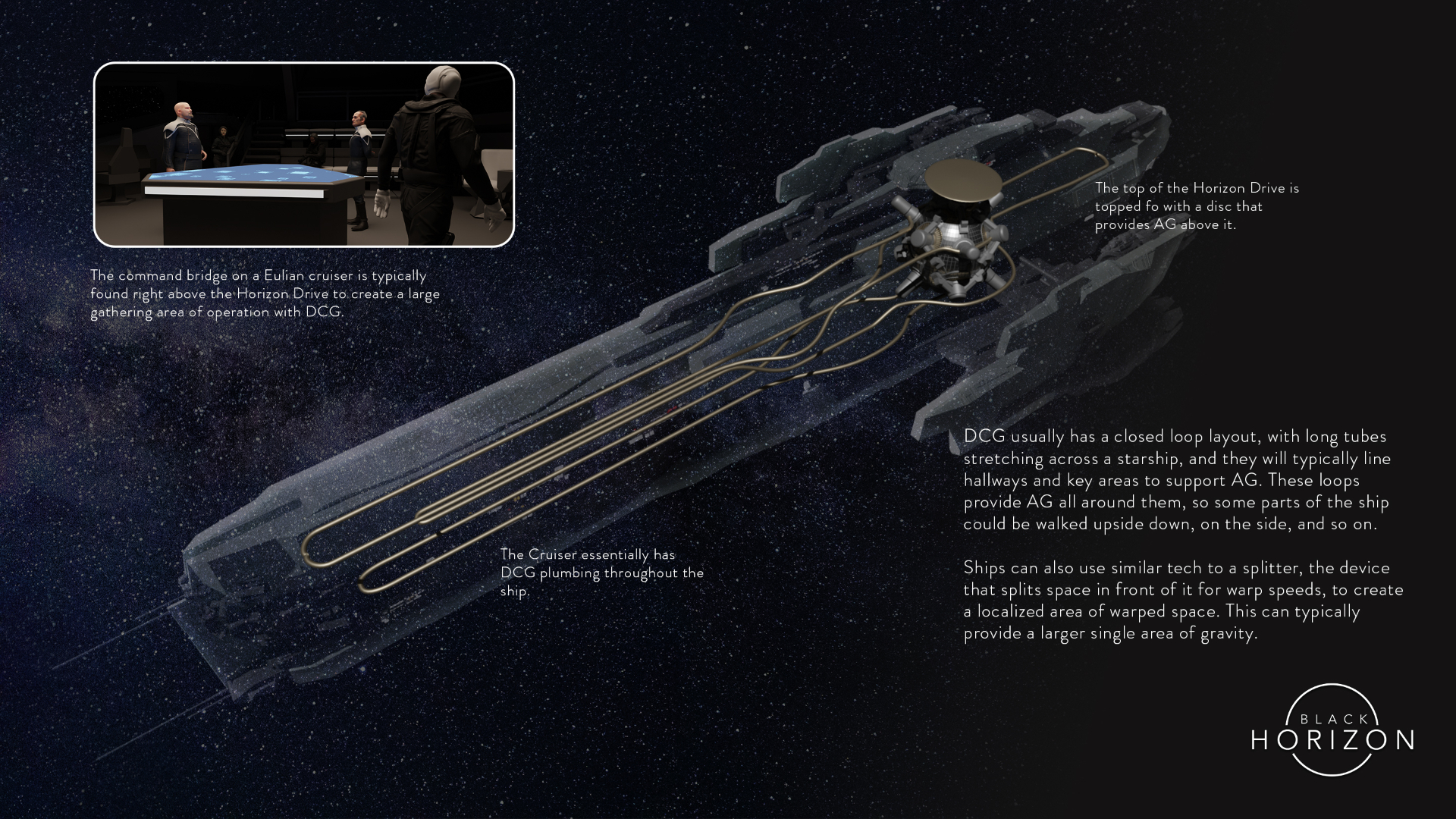
DCG usually has a closed loop layout, with long tubes stretching across a starship. They typically line hallways and key areas to support AG. These loops provide AG all around them, so some parts of the ship could be walked upside down, on the side, and so on. The cruiser essentially has DCG plumbing throughout the ship.
The command bridge on a Eulian cruiser is typically found right above the Horizon Drive to create a large gathering area of operation with DCG. The top of the Horizon Drive is topped with a disc that provides AG above it.
Ships can also use similar tech to a splitter — the device that splits space in front of it for warp speeds — to create a localized area of warped space. This can typically provide a larger single area of gravity.